

 Which degree is right for you?
 Master of Public Policy
 Master of Public Affairs
 Doctoral Program
 Undergraduate Programs
 Global and Executive Programs
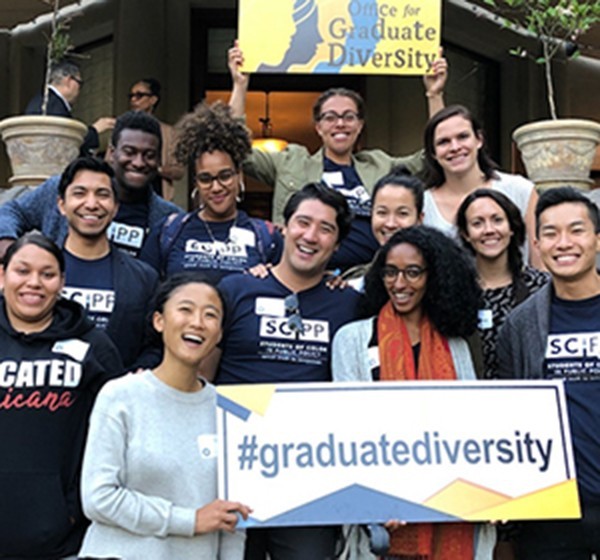
 Diversity, Equity, Inclusion
 Student Groups
 Alumni
 Directories
 Faculty
 Publications
 Working Papers
 Centers
 News Center

 Employment Stats
 Career Advising
 Career Resources
 Client-based Projects
 For Employers
 About GSPP
 Events
 Make a Gift
 Find a Program
 Find a Faculty Member
 Find a Center
Recent Publications
Crime, the Criminal Justice System, and Socioeconomic Inequality
Lofstrom, Magnus and Steven Raphael (2016), “Crime, the Criminal Justice System, and Socioeconomic Inequality,” Journal of Economic Perspectives, 30(2): 103-126.
2016-01-01Incarceration and Crime: Evidence from California's Public Safety Realignment
Lofstrom, Magnus and Steven Raphael (2016), “Incarceration and Crime: Evidence from California’s Public Safety Realignment,” The Annals of the American Academy of Political and Social Science, 664(1): 196-220.
2016-01-01Randomization inference for treatment effect variation
2016. Journal of the Royal Statistical Society, Series B. In press. (with P. Ding and L. Miratrix)
2016-01-01Applied researchers are increasingly interested in whether and how treatment effects vary in randomized evaluations, especially variation that is not explained by observed covariates. We propose a model-free approach for testing for the presence of such unexplained variation. To use this randomization-based approach, we must address the fact that the average treatment effect, which is generally the object of interest in randomized experiments, actually acts as a nuisance parameter in this setting. We explore potential solutions and advocate for a method that guarantees valid tests in finite samples despite this nuisance. We also show how this method readily extends to testing for heterogeneity beyond a given model, which can be useful for as- sessing the sufficiency of a given scientific theory. We finally apply our method to the National Head Start impact study, which is a large-scale randomized evaluation of a Federal preschool programme, finding that there is indeed significant unexplained treatment effect variation.
Follow the Money: School Spending from Title I to Adult Earnings
Johnson, Rucker C. (2015). “Follow the Money: School Spending from Title I to Adult Earnings”. Edited volume, ESEA at 50, The Russell Sage Foundation Journal of the Social Sciences.
2015-12-17Title I funding has been the largest federal program of K-12 education for the past 50 years with the objective to eliminate the educational disadvantage associated with poverty. I provide new evidence on the long-term effects of school spending from Title I on children's educational and adult economic outcomes. To study effects of Title I, I link school district spending and administrative data on Title I funding to nationally-representative data on children born between 1950 and 1977 and followed through 2011. Models include controls for birth cohort and school district fixed effects, childhood family and neighborhood characteristics, and other policies. I find that increases in Title I funding are significantly related to increases in educational attainment, high school graduation rates, higher earnings and work hours, reductions in grade repetition, school suspension/expulsion, incarceration, and reductions in the annual incidence of poverty in adulthood; effects on educational outcomes are more pronounced for poor children.
The Role of Social Security Benefits in the Turnaround of Older Women’s Employment Rate
With Adam Isen and Jae Song. Forthcoming in edited National Bureau of Economic Research volume, Women Working Longer, ed. Claudia Goldin and Lawrence Katz.
2015-12-13Interpreting INDCs: Assessing Transparency of Post-2020 Greenhouse Gas Emissions Targets for 8 Top-Emitting Economies
Thomas Damassa, Taryn Fransen, Mengpin Ge, Krisztina Pjeczka, Barbara Haya and Katie Ross (2015) Interpreting INDCs: Assessing Transparency of Post-2020 Greenhouse Gas Emissions Targets for 8 Top-Emitting Economies. World Resources Institute, Washington, DC.
2015-12-01Consumers' Willingness to Pay for Renewable and Nuclear Energy: A Comparative Analysis between the US and Japan
“Consumers' Willingness to Pay for Renewable and Nuclear Energy: A Comparative Analysis between the US and Japan” (with Kayo Murakami, Takanori Ida, and Makoto Tanaka), Energy Economics, 50, July 2015, pp. 178-189.
2015-12-01We investigate through a survey-based choice experiment US and Japanese consumer preferences for two alternative fuels, nuclear and renewable sources, as energy sources that have potential to reduce GHG emissions. The results for the US are similar across the four states sampled concerning consumers’ WTP for the reduction of air emissions: people are willing to pay approximately $0.30 per month for a 1% decrease in GHG emissions. Second, the average consumer expresses a negative preference for increases in nuclear power in the fuel mix in both countries. Japanese consumers have a stronger aversion to nuclear energy than US consumers. Third, US and Japanese consumers will pay more for emissions reduction with the use of renewable sources. Finally, we have shown that results like those found in this study can be useful in helping to set parameters for renewable energy policies like FIT rates and RPS stringency.
SNAP and Food Consumption
SNAP Matters: How Food Stamps Affect Health and Well-Being, Edited by Judith Bartfeld, Craig Gundersen, Timothy Smeeding, and James P. Ziliak, Stanford University Press, November 2015.
2015-11-01In this chapter, we describe the relationship between SNAP and food consumption. We first present the neoclassical framework for analyzing in-kind transfers, which unambiguously predicts that SNAP will increase food consumption, and follow this with an explanation of the SNAP benefit formula. We then present new evidence from the Consumer Expenditure Survey on food spending patterns among households overall, SNAP households, and other subgroups of interest. We find that a substantial fraction of SNAP households spend an amount that is above the program’s needs standard. We also show that the relationship between family size and food spending is steeper than the slope of the SNAP needs parameter, and that large families are more likely than small families to spend less on food than the needs standard amount. Actual benefit levels are smaller than the needs standards, and we find that most families spend more on food than their predicted benefit allotment. Because of this, according to the neoclassical model, most families are predicted to treat their benefits like cash.