
 Which degree is right for you?
 Master of Public Policy
 Master of Public Affairs
 Doctoral Program
 Undergraduate Programs
 Global and Executive Programs
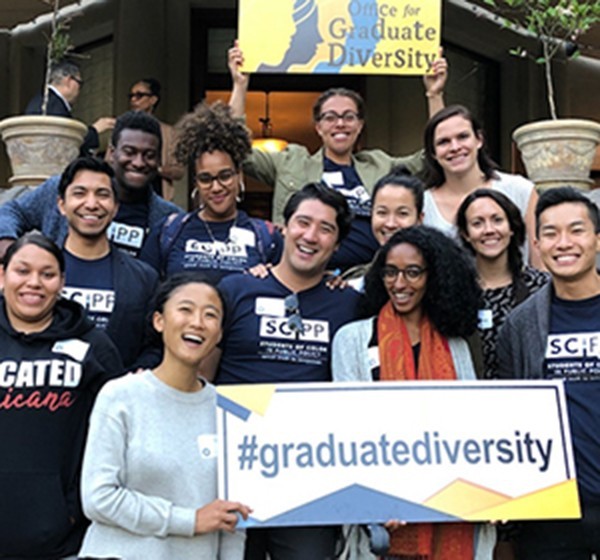
 Diversity, Equity, Inclusion
 Student Groups
 Alumni
 Directories
 Faculty
 Publications
 Working Papers
 Centers
 News Center

 Employment Stats
 Career Advising
 Career Resources
 Client-based Projects
 For Employers
 About GSPP
 Events
 Make a Gift
 Find a Program
 Find a Faculty Member
 Find a Center
Recent Publications
Timing and Turnout: How Off-Cycle Elections Favor Organized Groups
Anzia, Sarah F. 2014. Timing and Turnout: How Off-Cycle Elections Favor Organized Groups. Chicago: The University of Chicago Press.
2016-01-30World Scientific Handbook of Global Health Economics and Public Policy - Volumes 1-3
2016-01-27Compared to What? Variation in the Impacts of Early Childhood Education by Alternative Care-Type Settings
2016. Annals of Applied Statistics. In press. (with T. Grindal, L. Miratrix, and L. Page)
2016-01-22Early childhood education research often compares a group of children who receive the intervention of interest to a group of children who receive care in a range of different care settings. In this paper, we estimate differential impacts of an early childhood intervention by alternative care setting, using data from the Head Start Impact Study, a large-scale randomized evaluation. To do so, we utilize a Bayesian principal stratification framework to estimate separate impacts for two types of Compliers: those children who would otherwise be in other center-based care when assigned to control and those who would otherwise be in home-based care. We find strong, positive short-term effects of Head Start on receptive vocabulary for those Compliers who would otherwise be in home-based care. By contrast, we find no meaningful impact of Head Start on vocabulary for those Compliers who would otherwise be in other center-based care. Our findings suggest that alternative care type is a potentially important source of variation in early childhood education interventions.
Forked: A New Standard for American Dining
Oxford University Press
2016-01-14The More Things Change, the More They Stay the Same? The Safety Net and Poverty in the Great Recession
Journal of Labor Economics 2016, vol. 34, no. 1, pt. 2.
2016-01-10Much attention has been given to the large increase in safety net spending, particularly in Unemployment Insurance and Food Stamp spending, during the Great Recession. In this paper we examine the relationship between poverty, the social safety net, and business cycles historically and test whether there has been a significant change in this relationship during the Great Recession. We do so using an alternative measure of poverty that incorporates taxes and in-kind transfers. We explore the mediating role played by four core safety net programs—Food Stamps, cash welfare (AFDC/TANF), the Earned Income Tax Credit, and Unemployment Insurance—in buffering families from negative economic shocks. This analysis yields several important findings. Our most robust and important finding is the safety net is doing less to provide protection for the most disadvantaged. In the post-welfare reform world, TANF did not respond in the Great Recession and extreme poverty is more cyclical than in prior recessions. On the other hand, Food Stamps and UI are providing more protection¬-or at least providing no less protection-in the Great Recession, although these results are less robust across our different models. These programs are more likely to affect households somewhat higher up the income distribution; we find some evidence of a reduction in cyclicality at 100% poverty and little evidence about this at higher income-to-poverty levels.
Unemployment Insurance and Disability Insurance in the Great Recession
"Unemployment Insurance and Disability Insurance in the Great Recession," with Andreas Mueller and Till von Wachter. Journal of Labor Economics 34 (S1, pt. 2), January 2016. p.p. S445-S475. (On journal web site) (Appendix) (NBER digest summary) (Replication archive).
2016-01-05Social Security Disability Insurance (SSDI) awards rise during recessions. If marginal applicants are able to work but unable to find jobs, countercyclical Unemployment Insurance (UI) benefit extensions may reduce SSDI uptake. Exploiting UI extensions in the Great Recession as a source of variation, we find no indication that expiration of UI benefits causes SSDI applications and can rule out effects of meaningful magnitude. A supplementary analysis finds little overlap between the two programs’ recipient populations: only 28% of SSDI awardees had any labor force attachment in the prior calendar year, and of those, only 4% received UI.
Carbon Offsets in California: Science in the Policy Development Process
Barbara Haya, Aaron Strong, Emily Grubert, Danny Cullenward (2016) Carbon Offsets in California: Science in the Policy Development Process. In Communicating Climate-Change and Natural Hazard Risk and Cultivating Resilience, eds. Drake, J.L., Kontar, Y.Y., Eichelberger, J.C., Rupp, S.T., Taylor, K.M. Springer
2016-01-01Natural and social scientists are increasingly stepping out of purely academic roles to actively inform science-based climate change policies. This chapter examines a practical example of science and policy interaction. We focus on the implementation of California's global warming law, based on our participation in the public process surrounding the development of two new carbon offset protocols. Most of our work on the protocols focused on strategies for ensuring that the environmental quality of the program remains robust in the face of significant scientific and behavioral uncertainty about protocol outcomes. In addition to responding to technical issues raised by government staff, our contributions- along with those from other outside scientists- helped expand the protocol development discussion to include important scientific issues that would not have otherwise been part of the process. We close by highlighting the need for more scientists to proactively engage the climate policy development process.
Prison Downsizing and Public Safety
Lofstrom, Magnus and Steven Raphael (2016), “Prison Downsizing and Public Safety,” Criminology and Public Policy, 15(2): 349-365.
2016-01-01