 Which degree is right for you?
 Master of Public Policy
 Master of Public Affairs
 Doctoral Program
 Undergraduate Programs
 Global and Executive Programs
 Diversity, Equity, Inclusion
 Student Groups
 Alumni
 Directories
 Faculty
 Publications
 Working Papers
 Centers
 News Center
 Employment Stats
 Career Advising
 Career Resources
 Client-based Projects
 For Employers
 About GSPP
 Events
 Make a Gift
 Find a Program
 Find a Faculty Member
 Find a Center
Need to Repair and Revitalize our Democracy
A statement from Dean Henry E. Brady
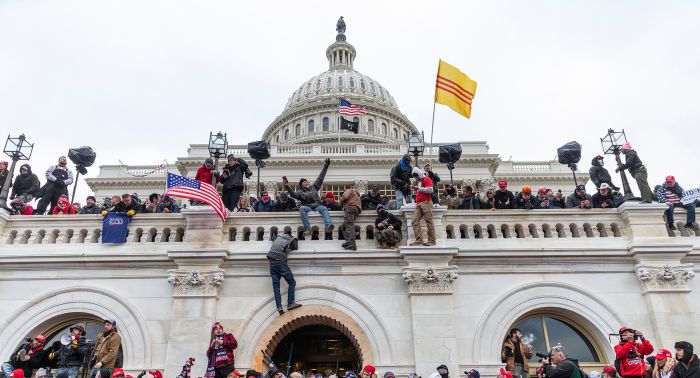
The insurrection of Wednesday, January 6th in our nation's Capitol building that attempted to subvert the electoral process not only reveals the anti-democratic stance of President Trump (see the blog post here and below), it also exposes the pressing need to restore democratic practices, norms, and laws. Public policy schools play a vital role in preparing people for public service and in providing advice to governments. As the Dean of a public policy school and as a lifelong student of democracy, elections, and voting systems, I strongly believe that we must advocate for a democratic renewal that will ensure the survival and persistence of democracy in America.
Blueprints for moving forward come from the work of two members of the Goldman School’s Advisory Board, one of whom graduated from GSPP and the other from Berkeley’s School of Information, a GSPP PhD student and a Berkeley PhD in political science, and two Berkeley faculty members. Their ideas deserve serious consideration.
Budd Shenkin, a pediatrician who founded the Bayside Medical Group after his graduation from Harvard Medical School and GSPP, has proposed a series of reforms for the post-Trump era that would provide a check on Presidential excess. These reforms include limiting the pardon power, protecting Inspectors Generals from dismissal, developing Congressional tools for criticizing the President that fall short of impeachment but that still carry weight, requiring the disclosure of tax returns for presidential candidates, and strengthening laws for disclosure by public agencies. Shenkin’s proposals aim to ensure Presidential accountability and responsiveness to the public and to Congress. Now, after January 6th, we can add to Shenkin’s list the need to seek accountability for those who both directly and indirectly permitted and supported the insurrection in DC.
A technique invented by Philip Stark, a Professor of Statistics at UC Berkeley, provides a starting place for improving our electoral system. Elections, he argues, should routinely produce public evidence that outcomes are correct. Currently, four states (Colorado, Nevada, Rhode Island, and Virginia) utilize Stark’s technique for “risk-limiting audits” that provide publicly verifiable proof that elections are fair and honest. Evidence-based elections cannot insure against lies and fabrications such as those we have seen from President Trump and others, but they can create a baseline for trust and review.
In a November 5, 2020 op-ed in the New York Times, Charlotte Hill, an MPP graduate and now a PhD student at GSPP, and her co-author Lee Drutman, a UC Berkeley PhD in political science, make the case for a Federal Elections Agency to replace the failed Election Assistance Commission. The agency would push for similar rules across states, simplified voting procedures, and active efforts to ensure election security. It would also provide national oversight over the welter of jurisdictions and rules. In their detailed proposal, they explain how to do it and why it is important.
Steve Silberstein, a member of GSPP's advisory board and a graduate of UC Berkeley's School of Information, has supported the National Popular Vote movement that would create an Interstate Compact that would guarantee the Presidency to the candidate who receives the most popular votes across all 50 states and the District of Columbia. Sixteen jurisdictions possessing 196 electoral votes have enacted the National Popular Vote Bill.
Lisa García Bedolla, Berkeley's Vice Provost for Graduate Studies and Dean of the Graduate Division, served on the Commission on the Practice of Democratic Citizenship that released Our Common Purpose: Reinventing American Democracy for the 21st Century in June 2020. That Commission presented a series of recommendations to ensure equal representation, to empower voters, to make government responsive and to connect communities, to make social media truly civic media, and to create a culture of shared commitment. With respect to voting, their recommendations included a call for same day and universal voting registration, moving national elections to Veteran’s Day (November 11th) which is a federal holiday, making voting easier through early voting and vote centers, pre-registration for 16 and 17 year olds, restoring voting rights to citizens with felony convictions, and universal required voting. Most of these reforms appear in Chapter 12 of my co-authored book, Unequal and Unrepresented: Political Inequality and the People’s Voice in the New Gilded Age. The Commission also proposed many other reforms such as independent redistricting commissions, 18-year terms for Supreme Court Justices, ranked choice voting, campaign finance reform, a public service mandate for social media, and improved civic education.
It was reassuring to see that Congress reconvened within hours after the destructive events of Wednesday of January 6th and that it completed its business by 4 am ET on Thursday morning, but much still remains to be done to ensure that our democracy gets stronger. Shenkin, Stark, Hill, Silberstein, Drutman, and Bedolla provide us with real reforms that would make a difference. The Goldman School of Public Policy is committed to these kinds of reforms and to a strong democracy, and it will continue to advocate for more and improved democracy.
Statement by Dean Henry Brady on Events in Washington DC on January 6th
The events in Washington, D.C., on Wednesday, Jan. 6, will go down as the most infamous ending of a presidency in the nation’s history, amounting to a foiled, but very real, attempt to subvert the electoral process that could be called a failed coup. While Donald Trump has shown no sympathy for the legitimate claims of those protesting George Floyd’s death, ever since the Nov. 3 election, he has made unsubstantiated and false claims about the legality and reliability of America’s voting systems. Scores of courts, many of them with judges that he appointed, rejected these claims, and none found significant problems. By urging his followers to come to a rally in Washington on Wednesday, by continuing to make false claims, by urging his supporters to walk to the Capitol and to ‘show strength,’ and by belatedly telling those who entered the Capitol to go home while tweeting, ‘We love you. You’re very special,’ Donald Trump put himself, again, on the side of chaos and disorder in support of his efforts to retain power. The bedlam of Wednesday’s events — including the parading of a Confederate flag through the Capitol — halved the number of senators who were willing to support him. Still, enough senators and members of Congress remained with him to mount unsuccessful bids to decertify the electoral votes of Arizona and Pennsylvania. Joseph Biden will be our president, but with our democracy undermined and legitimate claims ignored because Donald Trump manufactured a crisis. The new president and Congress must work very hard to put American democracy back together.
This statement, as well as reactions from other UC Berkeley faculty, can be found on Berkeley News