 Which degree is right for you?
 Master of Public Policy
 Master of Public Affairs
 Doctoral Program
 Undergraduate Programs
 Global and Executive Programs
 Diversity, Equity, Inclusion
 Student Groups
 Alumni
 Directories
 Faculty
 Publications
 Working Papers
 Centers
 News Center

 Employment Stats
 Career Advising
 Career Resources
 Client-based Projects
 For Employers
 About GSPP
 Events
 Make a Gift
 Find a Program
 Find a Faculty Member
 Find a Center
Professor Eugene Bardach on Lessons From a Former Student
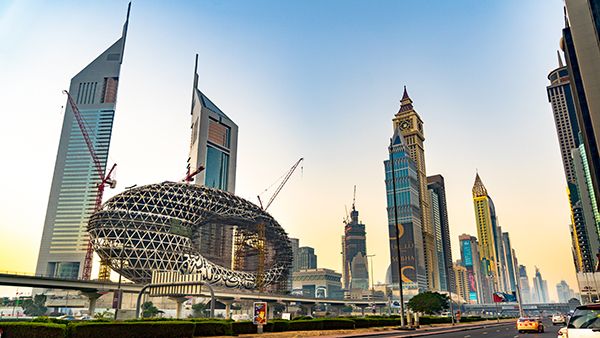
Professor Eugene Bardach reflects on a recent trip to Dubai
In February 2002, a recent alum, Al Fitzpayne (MPP '98) wrote me a delicious letter describing his success in a job search. He was one of two finalists for the position of tax and budget adviser to a US Senator. The decisive round of the selection contest was to be a mock memo to the Senator on an obscure question of US tax policy, about which he, of course, new nothing. “Panic.” But then: “The experience of having to sound intelligent on a topic I knew nothing about all of a sudden was no longer daunting, it was familiar” – the 48-hour project. Following some research, and flaunting a dubious reference to “the upcoming trade round in Doha, Qatar,” Al sent off the memo and got the job. "Any time you can mention Doha in a memo, I personally believe it should be done.”
When I was teaching IPA, I used to give a copy of Al’s letter to students just before they were to do their 48-hour projects. It was meant to be inspirational. (Also, it had some pragmatic value: do NOT do as Al did and take a two-hour nap before starting on the research.) Little did I realize that the inspiration would apply to me one day. But so it did.
A few weeks ago I was invited to do a training session on the Eightfold Path approach to doing policy analysis for a few of the 4000 people expected to attend the seventh annual World Government Summit, to be held in Dubai and under the auspices of the World Bank. The session was on a Saturday, the same day I got another invitation to attend a “by-invitation-only” session on Monday to help some folks from Saudi Arabia think about what they should do when, in 2020, they were to take over the (one-year) presidency of the G-20. Looking at the other email addresses on the invitation, I estimated that up to about 25 people might come, some half of whom would be academics (not all that many, actually, at the Summit) and the rest high government functionaries from a variety of countries plus some business and NGO people.
Knowing pretty much nothing about the G-20, I put myself in 48-hour-project mode: breathe deeply and assemble your vague recollections -- misinformation, misconceptions, and all. Reason where you might possibly find a treasure trove of information, and hunt for it. That would be the internet. In two hours I learned enough to get a good picture of what the G-20 was or wasn’t. “Wasn’t” was the main thing. The G-20 was a group of some 20 countries, mostly rich, represented by their top financial policy people, and an ad hoc creation of Larry Summers and a German financial bigwig in the later Clinton years, as part of a broader effort to stabilize global financial markets, as Asian currencies were falling and a major US hedge fund was going under. It then seemed to hibernate for almost ten years, until the global financial crisis of 2007-8 came along.
I could not figure out what the G-20 actually did, however, except meet, on average about once a year. Maybe nothing except to offer symbolic reassurance that somebody was paying attention and could or might coordinate action if it turned out that coordinated action would make sense. And even if it wouldn’t make sense.
The G-20 seemed to have status but no power. Rhetoric but no resources. They didn’t even have a secretariat but mooched off the resources of the OECD. But sometimes exhortation works, and consensus counts. Excluded countries, and their advocates who sometimes took to the streets protesting the composition of the G-20, seemed to think so.
The G-20 presidency part of the equation on which our meeting would focus remained a mystery, however. On this, the internet was no help. So too, of course, did the aspirations and interests and capabilities of the Saudi kingdom in the presidency role. But I had a theory of how this meeting would go and how I could fill in the blanks if I just sat still and listened carefully for an hour. My theory told me that the meeting would be a form of theater. The script would entail the Saudi chair going around the room asking people in turn what they had to recommend. The recommendations would take one to five minutes apiece and would, in each case, focus on what global problem should have priority claim on the attention of the G-20, whatever that might mean. Before this round-robin would finish, we would probably hear: climate change, extreme poverty, the status of women, financial instability, etc. In one-to-five minutes, what else could people do, after all?
My prediction was 100% right. So what should I get behind? I had no good advice. Whatever I might say would be based on a casual reading of the newspaper plus some pretty flaky theory about what could be done to address the problem. That was my interpretation of the quality of advice everybody else was offering. So why follow in those footsteps? And anyway, the Saudis would inevitably do whatever their own values and implicit theories directed them to do.
What to do? Well, surely ignorance and naivete are of some value sometimes. Who but a small child would say the Emperor had no clothes? Waving my hand to get the chair’s attention, I offered: “You can’t make a mistake choosing a priority here. These are all important problems. But from my internet reading, I see the G-20 has status – people will notice what you think and say – but no power. Their noticing will not last very long either. What you need is partners. Institutions with resources and leverage who will help you out – and whom you can help out.” After the meeting, the Saudi chair practically embraced me. I think I had said what he knew already but about whose legitimacy he had been a little uncertain. The suppositions of even an unfamiliar American academic were of some value.
Thank you, Al Fitzpayne.
Photo by Darcey Beau on Unsplash