

 Which degree is right for you?
 Master of Public Policy
 Master of Public Affairs
 Doctoral Program
 Undergraduate Programs
 Global and Executive Programs
 Diversity, Equity, Inclusion
 Student Groups
 Alumni
 Directories

 Faculty
 Publications
 Working Papers
 Centers
 News Center

 Employment Stats
 Career Advising
 Career Resources
 Client-based Projects
 For Employers
 About GSPP
 Events
 Make a Gift
 Find a Program
 Find a Faculty Member
 Find a Center
GSPP / Berkeley Law Alum on Frontlines of Challenging Trump Immigration Policies
By Alex Pfeifer-Rosenblum, MPP ‘21
When GSPP alum and social entrepreneur Karen Tumlin (MPP ‘03/JD ‘04) chose to become an immigrants’ rights attorney, she would never have guessed that immigration would one day become among the country’s most hotly contested issues. Nor could she have foreseen that a US President would select immigration as the centerpiece of his campaign and top policy concern.
“Like many people working on immigrant rights, it started as a personal issue,” Tumlin recalls. “My mother is an immigrant from Newfoundland, and I grew up connected to communities both here and in Canada. It was a turning point when I realized that the privileges I have in my family – for example, being able to travel and spend time with my grandparents when they were dying – is a luxury not all immigrants have. I wanted to make changes to our laws and policies so that all immigrant families can live with basic dignities.”
Prior to founding the Justice Action Center – an innovative organization filling critical gaps in advocacy for immigrants – Tumlin successfully litigated numerous cases of national significance, including a challenge to the Trump Administration's effort to end the DACA program and the Muslim Ban, as well as the constitutional challenge to Arizona’s notorious anti-immigrant law, SB 1070.
These experiences have given Tumlin an opportunity to work in the communities experiencing the most disruptive effects of our country’s harsh immigration policies. One of her clients – a man who was persecuted in Iraq for becoming a translater for the US Army – lost his right to enter the United States midair after the Muslim Ban was issued during his flight.
“He was detained and wrist-tied at JFK for many hours. That was not the welcome that he expected after helping the US Army,” Karen recalls. “But when he finally came out, he remembered seeing the organizers and a Catholic nun in full habit holding a sign that said ‘refugees are welcome here.’ And he said, ‘Ah, this is America: religious freedom!’ What’s always stuck with me is the way in which, despite his treatment, he was also seeing the best of our country.
“Yet for all of the attention of those powerful moments and wins, we now have a situation, for example, where Iranian-Americans cannot bring their family members into this country. It’s causing enormous family separation. It’s very painful to me that this is off the public consciousness. If that was your community, it would be in your consciousness.”
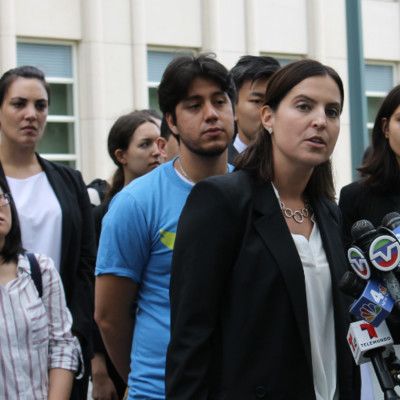
Tumlin also presented oral arguments to the US Supreme Court challenging the Trump Administration's efforts to end DACA. Tumlin’s team was involved in efforts to bring several DACA recipients into the court building during arguments.
“It was so important to ensure space in that very fancy, highfalutin setting for the actual people who are impacted to be present,” says Tumlin. “And then there was a rally outside that took over the streets. I had the job of walking out with the plaintiffs and DACA recipients and pushed the heavy court doors open for them. We heard the rally participants shout, ‘the plaintiffs are here!’ There’s this moment captured on video where the plaintiffs and members of the rally were chanting ‘home is here,’ which was the campaign’s theme or hashtag. That moment – where the nation’s highest court was very much connected to a person-driven, organizer movement outside of the Supreme Court – was really the most striking thing that I’ve seen in my legal career in terms of connecting what happens inside our courtroom to our lives outside.”
During the Trump era, the need for immigration advocacy has grown exponentially. “We’re literally at a stage where we have hundreds of Trump immigration changes,” says Tumlin. “This has put an imperative on all of us in the field to be more strategic, and to build teams with fewer people so that we can spread out and take on the unmet need.”
Addressing unmet needs was one of Tumlin’s primary goals when she founded the Justice Action Center. “Based on my fifteen years of working in this field, I noticed that a couple of things were missing from the environment,” Tumlin explains. “First, it is so important to challenge the top headline-grabbing issues of the day. And luckily, we have an environment where there are really sophisticated organizations involved in these issues. But there’s plenty that falls between the cracks, or what I like to call a lot of unseen problems that need to be seen. What I came to realize was that to take on the unmet need, you needed to create an organization where that was the brand, the organizational DNA, what was valued as a success.
“The other reason I founded Justice Action Center was that, unfortunately, I am old enough to be bringing cases that are similar to the types of cases I fought and won when I first started my career. That means we must not be doing something right. I see that in part as a failure to effectively utilize the current digital and communications environment. I wanted to create an organization that was engaged in using not just communication strategies, but digital organizing strategies, and data analytics. You can put out a high-quality video that’s compelling, and measure whether it got a million views. But if those million viewers are all people who are already attuned and active on the issue, you are talking to your own echo chamber. I’m more interested in inspiring a new audience to engage on an emotional level about these basic dignities that everyone should have, regardless of immigration status.”
Despite being only a year old, Justice Action Center has already achieved success. One recent victory related to the Trump Administration’s October 4, 2019 Executive Order banning healthcare for immigrants. “Almost nobody has heard of it, even though this proclamation sets the record in terms of the number of legal immigrants or people qualifying for green cards it affects,” says Tumlin. Under the executive order, up to 375,000 people will not qualify for healthcare unless they can demonstrate their ability to pay out-of-pocket for reasonably foreseeable health care costs, or can buy into a limited set of approved plans. If an individual cannot show that they meet these qualifications, they are denied entry into the United States.
“This impacts legal immigrants as well as people who have met all of the criteria and have been granted permission to have a green card. We are talking about, for example, the husband, wife, or parent of a US citizen, or someone who has been granted permission for an employer-sponsored green card. And here’s the really crazy thing: their approved list consists of what are often referred to as ‘junk’ healthcare plans. The plans don’t actually provide coverage. Obamacare, which is open to green card holders to purchase on the exchange, is prohibited. The stated purpose is to improve our healthcare system – but in reality, it weakens the system by routing people to junk plans and kicking people off the exchange.”
When the executive order was released, Tumlin’s team noted that the proclamation was based on the same argument as the Muslim Ban, and began to search for an organization to challenge the order. “But, understandably, because so many organizations are involved in challenging all these other hundreds of policies, there was no capacity to take on the lawsuit. So we took it on. We rushed to file a lawsuit before it was scheduled to take effect. We were able to get an injunction that stopped it.” This allowed an estimated 100,000 people to obtain green cards.
Tumlin believes that her joint MPP-JD has uniquely positioned her to effectively navigate public institutions. “The courtroom is one thing, but if we’re talking about the DACA lawsuit, you have potential congressional legislation and presidential orders at play. So I think that my joint MPP-JD has given me the ability to handle what we sometimes call that three-ring circus at the same time.”
Forever a California Golden Bear, Tumlin also applauds the UC system’s active support for immigrant rights. “I’ve worked with Goldman School professors, and their colleagues at the department of economics, who have provided written testimony on the effects of immigrant workers on the economy, including on wages and employment for native-born US workers,” Tumlin reflects.
“And of course, the UC system itself is part of the DACA cases. And I think that’s something that we should be proud of.”