 Which degree is right for you?
 Master of Public Policy
 Master of Public Affairs
 Doctoral Program
 Undergraduate Programs
 Global and Executive Programs
 Diversity, Equity, Inclusion
 Student Groups
 Alumni
 Directories
 Faculty
 Publications
 Working Papers
 Centers
 News Center

 Employment Stats
 Career Advising
 Career Resources
 Client-based Projects
 For Employers
 About GSPP
 Events
 Make a Gift
 Find a Program
 Find a Faculty Member
 Find a Center
Goldman Students Participate in Berkeley’s Inaugural Palestine Trek
UC Berkeley graduate students traveled throughout the West Bank to engage with the geopolitical history and lived realities of occupation
Emnet Almedom, Christopher Dokko, Robyn Levinson, Pauline Miller, and Anthony Rodriguez
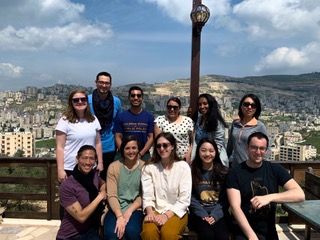
Palestine Trek (PalTrek) is a student-led venture designed to enrich the perspectives of the next generation of legal, business, political, and civil society leaders and advocates in the U.S. For the first time, graduate students from UC Berkeley—from, the Goldman School of Public Policy, Berkeley Law, Haas Business School, the School of Journalism, and the School of Social Welfare, among others—traveled throughout the West Bank to engage with the geopolitical history and lived realities of occupation. This trip provided an opportunity for us to bear witness to the methodologies of social control constituted by law and policy and relate them to contemporary American political discourse andresistance movements.
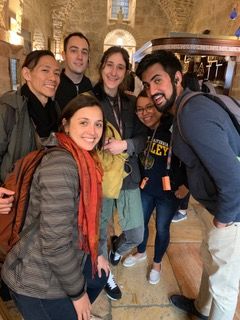
Over the course of seven days, we traveled to spaces of historical and cultural significance, such as the canonical birthplace of Jesus and the Dead Sea. We visited non-profit organizations, universities, refugee camps, and artist workshops and spoke with community, business, political, and student leaders. We were joined by cohorts from schools including Harvard, University of Chicago, and MIT.
For the GSPP cohort, our motivation to attend emerged not only from our status as policy scholars and future practitioners, but also from our position of privilege as graduate students in American universities. We felt a tension between the spaces we inhabit and the communities we serve. For us, Palestine was not a way to resolve that tension; rather, it was a way to lean into it.
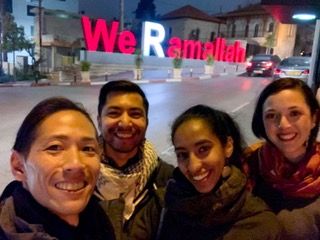
Moreover, the Trek offered a truly unique opportunity to examine that tension through a policy lens. Historical Palestine (which includes modern-day Israel) is neither historical, nor “foreign”: it is a prism that continues to refract contemporary law, politics, and policy. We felt that it was and is our responsibility as future public servants and leaders to critically investigate our most profound contestations—not in the abstract, but on the ground. For us, this meant the literal ground of Palestine.
As Americans, this trek further offered the opportunity to confront Islamophobic discourses that have, particularly since 9/11, distorted our national vision of the Southwest Asian and North African region. For some of us, PalTrek marked our first encounter with Muslim-majority geographies—and our travels took place against the backdrop of a shifting political landscape. The recent elections of congresswomen Ilhan Omar and Rashida Tlaib have marked the emergence of anti-occupation voices in places of power. Their opposition has mobilized other Democratic operatives to publicly question American foreign policies and the role of political lobbies like AIPAC in shaping it. As a nation, our conversation is turning toward the Palestinian struggle and, as future policy practitioners, we now possess the contextual insight to make sense of it. 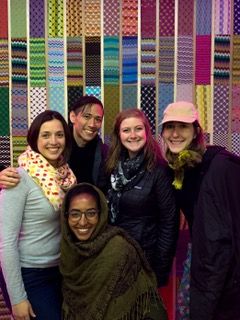
We also recognize that religion and politics have long been connected. Visiting the birthplace of the Abrahamic religions provided a meaningful exercise in merging our political intellect with our personal experiences of faith. In the Old City of Jerusalem, at the Al-Haram al-Ibrahimi mosque, and within the Church of the Holy Sepulchre, we witnessed the long-standing, if tenuous, agreement to share religious space. Through a policy lens, we reflected upon the power of religion to both unify and to oppress; how religious ideologies can become political ones and, therein, the ostensibly moral grounds upon which to grant or deny civil rights, liberty of movement, and even life itself.
The Trek served as a stark and necessary reminder of the ways in which policy is a double-edged sword that can transform or maintain such systems of power. The impacts of policy were not theoretical exercises in the classroom, but material constructions in the West Bank—literally, as Israel’s separation wall surrounded and constrained us. This wall reaches a height of 25 feet in some places and is continuously guarded by Israel’s military. It was erected in the name of “security” and, for us, was also a jarring glimpse into the consequences of political rhetoric that is echoed by voices of support in America for a “big, beautiful wall.”
Importantly, PalTrek did not focus only on modes of oppression, but also on the struggles to resist it. We were privileged to learn from a diverse set of activists, from Israelis engaged in anti-demolition work to Palestinian scholars leading the Boycott, Divestment, and Sanctions (BDS) movement. They frequently drew upon global and intersectional themes that tie the Palestinian struggle to struggles everywhere, to the legacy of colonialism and imperialism across Southwest Asia, Africa, and Latin America. Stories of resistance to state violence reminded us of our own country’s continuing—and, similarly, often legal—brutalization of black and brown youth. And what the U.S. has done at home, it also expressly makes possible abroad. As we grow into our policy careers, we intend to carry this knowledge with us.
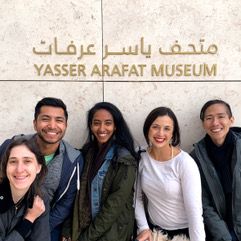
Such lessons are embedded within us and within the connections we forged with both Palestinians on the ground and the multidisciplinary cohort of Berkeley graduate students with whom we traveled. The Trek provided us with a wonderful opportunity to build community with students outside of GSPP—new friends with diverse and knowledgeable perspectives that encouraged us to elaborate our understandings of injustice. We are eager to share these newly articulated understandings with our communities at GSPP, in Berkeley, and wherever there are those seeking justice and understanding. To that end, some of us are staying involved in Palestinian human rights efforts by working with the Right 2 Education campaign, launched at Birzeit University, to support access to education for Palestinians. We also implore all future GSPP students to consider attending future iterations of Palestine Trek.
Above all, we are humbled by this opportunity to humanize our policy lens, to breathe life into data with human stories and faces. Even for those of us intending to pursue policy work in the Bay, Palestine is here. We shared a meal with a university student whose brother, quite coincidentally, lives down the street from us in Oakland. The anti-displacement organizing we learned about in Akka paralleled strategies used in West Oakland; and, we came across murals in the West Bank that quoted rap lyrics from Bay Area artists. Our world so often feels large and complex, but the human differences between us are in fact small. It is only through human connections that we may fully understand our roles as global citizens and grow into becoming more responsible policy-makers