
 Which degree is right for you?
 Master of Public Policy
 Master of Public Affairs
 Doctoral Program
 Undergraduate Programs
 Global and Executive Programs
 Diversity, Equity, Inclusion
 Student Groups
 Alumni
 Directories
 Faculty
 Publications
 Working Papers
 Centers
 News Center
 Employment Stats
 Career Advising
 Career Resources
 Client-based Projects
 For Employers
 About GSPP
 Events
 Make a Gift
 Find a Program
 Find a Faculty Member
 Find a Center
Recent Episodes
Parks. Freeways. Street lamps. You might not group those together, but they’re all public goods – the goods and services that prop up a functioning society. They’re also things that our market-based economy doesn’t supply in the right places and right amounts without some thoughtful public policy.
Spencer Bowen (MPP ’20) sat down with his fellow MPP candidate Eric Harris Bernstein to talk about public goods – and specifically public restrooms.
In this episode, you’ll hear a broad overview of public goods, takes on ongoing bathroom-centered equity battles, scholarly perspectives on restrooms’ place in our culture, and much more. You’ll also hear a story about bathrooms that Eric produced in the fall for North Gate Radio’s “The Fix,” a radio show about public policy solutions.
What has California’s marijuana legalization meant for those growing the plant? Are their lives better or worse under the new laws?
Jaunary 2019 marked the one-year anniversary of the legalization of recreational cannabis use in California, and the launch of the Cannabis Research Center at UC Berkeley. Sarah Edwards (MPP ‘20) sat down with Michael Polson, researcher and anthropologist, to discuss the impact of legalization on the growers and on the rural communities whose economies often center on cannabis cultivation. Tune in to unpack the equity concerns of the new process, the role of stigma in media narratives, and the personal implications of these changes.
Interested in learning more? Check out:
- UC Berkeley's Cannabis Research Center
- Michael Polson’s publications—“From Outlaw to Citizen: Police Power, Property, and the Territorial Politics of Medical Marijuana in California’s Exurbs“ is a very accessible starting point
- California’s cannabis laws and regulations
In Part 2 of our 2-episode carbon footprint series, TPTM hosts Reem, Spencer, and Sarah reflect on the results of their two-week-long challenge to drastically reduce their personal carbon emissions through changes to their diets, commutes, consumption habits, and electricity use. But do individual emissions reductions matter when corporations and industries continue to pollute with impunity? We can’t achieve ambitious climate goals – like California’s pledge to reduce emissions to 40% below 1990 levels by 2030 – through individual actions. So what else will it take?
Reem turns to Bob Epstein of Environmental Entrepreneurs, and then Professor Dan Kammen of the Goldman School, to learn about the transformations in technology, policy, and the environmental movement as a whole, that will facilitate success in climate mitigation. In this episode, we discuss the technological potential of carbon sequestration, China’s political advantages in climate progress, the benefits and pitfalls of market-based climate regulations, the future of the environmentalist movement, and what Bob eats for breakfast.

For this special edition episode, hosts Reem, Spencer, and Sarah talk about what it means to talk policy.
How do they explain policy and policy school? Why do they think that it is important to talk about policy?
Our three hosts are first-year students at the Goldman School of Public Policy’s Master in Public Policy Program. They each bring different perspectives and background to the master’s program and to the podcast. Tune in to hear what brings them to the table (and to the recording studio) and what drives all of us at Talk Policy to Me.
1.5 degrees Celsius. According to a special 2018 report from the UN’s Intergovernmental Panel on Climate Change, that’s the maximum global temperature increase allowable before we see catastrophic impacts on food security, ecosystems, water access, frequency and extremity of weather events, and more. The report warns global leaders and policymakers that failing to limit the Earth’s temperature increase will result in a world that is unrecognizable – and extremely difficult to live in.
Given the urgency and magnitude of climate change, what are individuals’ role in helping to limit global temperature increase to 1.5 degrees Celsius? How do our lives and habits need to change? How does our responsibility, as residents of the wealthiest country in the world, compare to those living in poverty? And how does individual responsibility for carbon reduction interact with corporate and industrial responsibility? Does it matter that we recycle and buy local produce and use public transit when the US continues to buy oil from Saudi Arabia and 85% of Americans drive to work?
To get to these questions, TPTM reporter and Goldman MPP student Reem Rayef spoke with Chris Jones, Director of the CoolClimate Network and developer of the CoolClimate Calculator. The calculator is an online interactive tool that calculates users’ carbon footprints (the amount of CO2 they emit per year) using information about their homes, consumption habits, and lifestyles. The calculator then provides custom recommendations to users on how they might “green” their lifestyles – from buying an electric vehicle to eating a vegetarian diet. The calculator can be accessed here: https://coolclimate.berkeley.edu/calculator

In this episode, the Talk Policy To Me team also kicks off a two-week challenge to drastically reduce their carbon footprints, using recommendations generated by the CoolClimate Calculator. TPTM hosts Reem, Spencer, and Sarah set goals and discuss challenges of living on low-carbon diets while being students with limited time and budgets.
Stay tuned for Part II of this two-episode series on personal carbon accounting.
Speakers featured on this episode

Chris Jones is Director of the CoolClimate Network, a university-governmet-industry partnership at the University of California, Berkeley. His primary research interests are carbon footprint analysis, community-scale greenhouse gas mitigation, environmental psychology and environmental policy.
Jones lead the development of the first carbon footprint calculators to account for the greenhouse gas emissions of all transportation, energy, food, goods and services purchased by households and businesses. This comprehensive method, called "consumption-based greenhouse gas accounting," powers a suite of online tools that allow households, businesses and communies to estimate their complete carbon footprints, compare their results to similar users, and develop personalized climate action plans to reduce their contribution to climate change. Versions of these tools have been adopted by governments, businesses and non-governmental organizations throughout the United States and internationally. CoolClimate also develops and evaluates programs to engage, educate, motivate and empower individuals to take climate action. Examples include the Cool Campus Challenge and the CoolCalifornia Challenge. He also serves as Program Chair (8th year) of the Behavior, Energy and Climate Change Conference.
How can we fix the stigma around welfare?
Welfare is deeply politicized and often stigmatized. Social support programs are strongly centered around beneficiaries working. Has it always been this way? Are we destined to be stuck with these political perspectives?
In today’s episode, UC Berkeley MPP student Sarah Edwards wraps up the three-part series around Universal Basic Income and the Social Safety Net. She examines a crossroads moment in our nation’s history when the Social Safety Net conversation began to talk about the “deserving” vs “undeserving” poor.
She then speaks with the California Budget and Policy Center’s Sara Kimberlin to explore California’s new policies driving the future of our safety net—and how we might not be as far from a UBI as it seems.
Special thanks to James Hawkins (MPP '18) for research support on this episode.
Interested in more on the UBI, social safety nets, and the complicated history of welfare policy? We recommend you try out the following:
- Listen to part 1 and 2 of this series—Part 1 features Goldman Professor Hilary Hoynes and Part 2 features Lori Ospina, the former director of the Stockton Economic Empowerment Demonstration (the first basic income demonstration in the United States).
- Read Brian Steensland’s book, The Failed Welfare Revolution: America’s Struggle Over Guaranteed Income Policy, that dives into the historic attempts to guarantee Americans basic economic security.
- Explore the California Budget and Policy Center’s reports on the impact of the CalEITC
NIMBYism, geographical limitation, and weaponized policies have led the state to the biggest housing crisis in state history. Can state-level policies fix a very local problem?
California housing is an undeniable problem. Rents are too high and there is not enough housing for those who need it in the places they want it. But how did we get here? Why has the development of solutions shifted from a city level to a state level? UC Berkeley MPP student Spencer Bowen speaks with Ophelia Basgal and Elizabeth Kneebone from the Terner Center and California Assemblyperson David Chiu. Here are five intersecting causes of California’s housing crisis that they help identify:
- Limited land and diverse geography
- Production not keeping pace with booming job market
- Housing is expensive to build and new methods are limited
- Cities wield their power to slow down or vote down projects that they don’t like
- Proposition 13 and the California Environmental Quality Act have been weaponized to limit housing production
While this feels grim, all three of our guests share reasons to believe the future can change for the better. As Governor Newsom takes a strong stand on housing, California looks to rebuild a set of broken policies. Tune in to learn more!
Wondering how to dive deeper into the history of California’s housing problem and the future of policy change? Here are some thought from the team:
- Attend the monthly “Food for Thought: Lunch Series” on California Housing Crisis and Potential Solutions, sponsored by the Berkeley Institute for the Future of young Americans and the Terner Center for Housing Innovation.
- Watch Governor Newsom’s speech on his budget proposal, where housing featured strongly. Read the overview of the governor's proposed budget.
- Check out the blog from the Terner Center for Housing and Innovation at UC Berkeley.
Additional music heard on this episode is by Blue Dot Sessions. Photo by Ananth Pai on Unsplash.
UC Berkeley will spend $30 million on building new softball and beach volleyball teams. While Title IX is widely understood to be a sports equity law, its historical advancement of feminist interests and its application at Cal today reveal a more ambitious and inclusive agenda. Not merely a mechanism for intercollegiate sports, Title IX advocates for building holistic inclusive collegiate experiences and making that ethos integral to the operations and strategy of the university.
UC Berkeley MPP ‘20 Spencer Bowen talks with Meagan Owusu, Head Beach Volleyball Coach at Cal and campus directors Denise Oldham and Jenny Simon O'Neal of Cal Athletics and Title IX programs to discover why Title IX is a flash point that opens opportunities, but also underscores the societal role of universities to foster the personal and professional growth in its students.
In our last episode on universal basic income, or UBI, a conversation between UC Berkeley MPP ‘20 student Sarah Edwards and Economics and Public Policy Professor Hilary Hoynes revealed that the landscape for UBI proposals and experiments is ripe.
In this episode, Goldman School student Sarah Edwards interviews Lori Ospina, about Stockton’s guaranteed income program, Stockton Economic Empowerment Demonstration (or SEED for short). With a $1 million grant, SEED will distribute cash to 100 residents falling below the area’s $64,000 area median income. Although modest in scale, SEED’s potential to ignite other policy conversations on UBI on the local and state level is much greater in magnitude.
With growing acknowledgment of a wealth gap in the U.S., Stockton’s program could be dually meaningful -- for the residents of this Central Valley city and for future conversations on social safety nets.
Professor of Economics Hilary Hoynes and UC Berkeley MPP Student ‘20 Sarah Edwards probe whether work is a solid foundation on which to build the welfare of American society. Can and should income from working really provide a stable base for all Americans? And can more universal coverage social safety nets for non-working adults alleviate the stigma of government support?
While welfare reform of the 1990s resulted in spotty coverage from the coupling of assistance and working, the universality of UBI could be an attractive counterproposal to extend coverage to those without it and reduce the stigma of government support. But untargeted programs risk becoming prohibitively expensive or overstretched.
In this episode of Talk Policy to Me, find out why loosening the bind between working and government support opens a new space where new possibilities for policy solutions can come forward.
Tune in to next week’s episode on the specifics of one experiment in Stockton, California.
Speakers featured on this epsiode
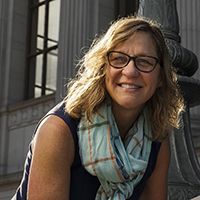 Hilary Hoynes is a Professor of Public Policy and Economics and holds the Haas Distinguished Chair in Economic Disparities at the University of California Berkeley where she also co-directs the Berkeley Opportunity Lab. She is a member of the American Academy of Art and Sciences and a Fellow of the Society of Labor Economists. She has served as Co-Editor of the American Economic Review and the American Economic Journal: Economic Policy and is on the editorial board of the American Economic Review: Insights.
Her research focuses on poverty, inequality, food and nutrition programs, and the impacts of government tax and transfer programs on low income families. Current projects include evaluating the effects of access to the social safety net in early life on later life health and human capital outcomes, examining the effects of the Great Recession on poverty, and the role of the safety net in mitigating income losses.